How to Run a Fake Door Test That Measures Intent, Not Curiosity
A fake door test is the cheapest way to validate an idea before you build it, if you set the threshold first, tell clickers the truth and ask for something that costs them. A worked example with the arithmetic.
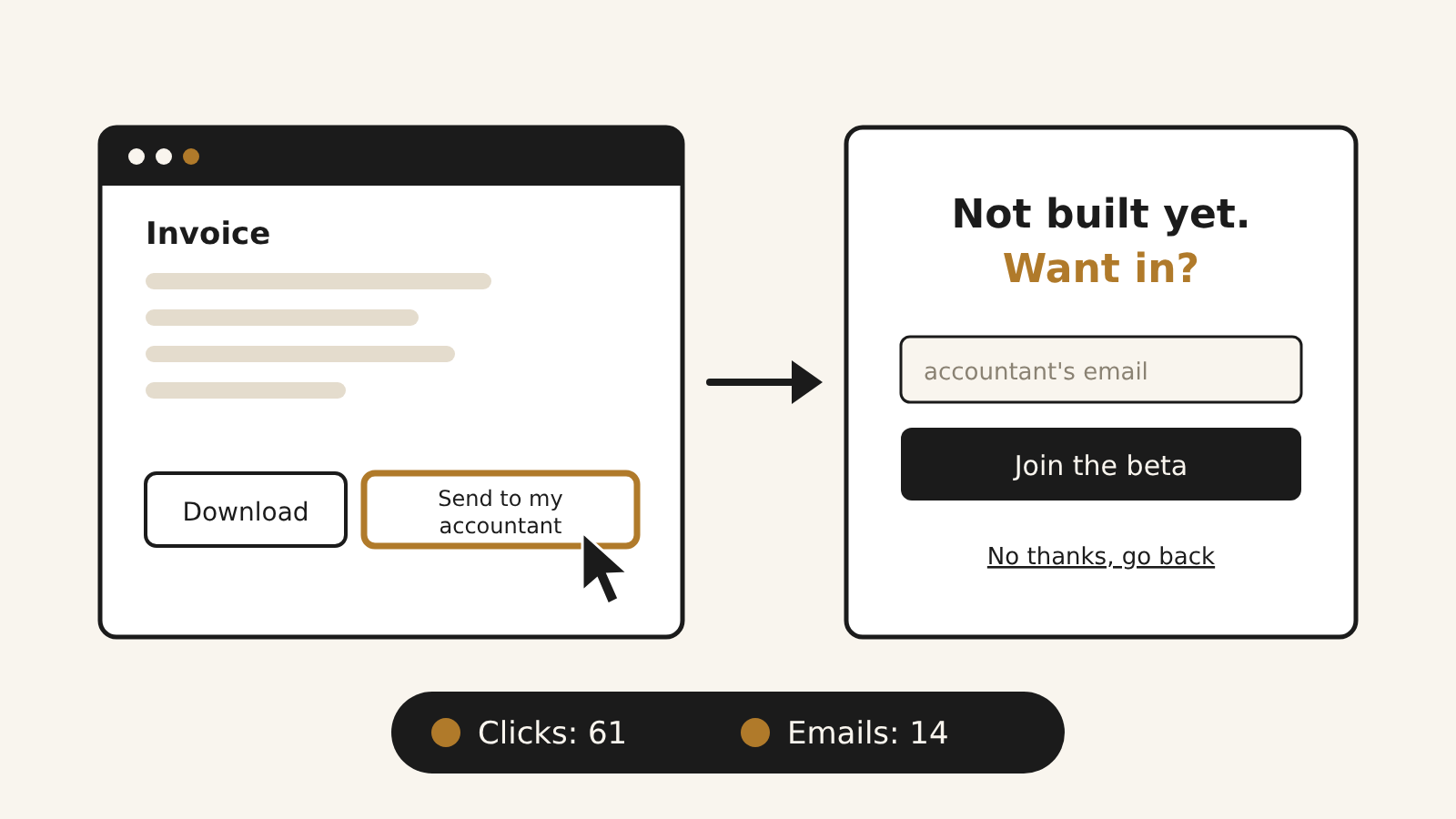
A fake door test puts a real button for a feature you have not built inside your product or on your site, counts who clicks it, and tells every clicker the truth straight away. Run well, it is the cheapest way to validate an idea before you write the code. Run badly, it measures curiosity and calls it demand.
The difference is in four decisions you make before anyone sees the button: which assumption it tests, what number would prove you wrong, what the clicker is asked to do next, and how many people need to see it before you read the result.
Name the assumption so it can fail
"Users want exports" cannot fail. Any click supports it, and so does no click, if you squint ("they just didn't see the button").
Write the assumption as a sentence with a group, a behaviour and a threshold:
Of active users who send at least one invoice a week, at least 4 in 100 will click "Send to my accountant" when it sits next to Download, and at least a third of those clickers will leave their accountant's email to join the beta.
Now the test can say no. Write the threshold down before launch, somewhere the team can see it, and do not move it afterwards. A threshold set after the data arrives always lands just below whatever came in.
How do you pick the number? Work backwards from what the feature has to earn. If building it costs six weeks and only pays off when a meaningful share of weekly users rely on it, a 0.5% click rate is a no, however excited the three people who clicked sound. If you cannot say what rate would be worth building for, you are not ready to test.
Build the door, and the honest room behind it
The button has to look like every other option on the page: same size, same weight, same place a real feature would go. A bright banner reading "NEW!" measures novelty, not need.
What the clicker sees next matters more than the button. Say plainly that the feature does not exist yet, that you are deciding whether to build it, and that their click helped. Then make one ask. Never pretend it is loading, never show a fake error, never take money for something that does not exist. Tricking users is a fast way to lose the trust you are trying to measure, and it is the kind of growth hack this blog will not recommend.
A fair message reads like this: "We haven't built this yet. We're deciding whether to. If you want it, leave your accountant's email and we'll invite you to the first version." Then a field and a button, and a quiet way back.
Make the second step cost something
A click is the weakest evidence a fake door can produce. It costs the user one second and tells you they were curious. The step behind the door is where you learn whether they care.
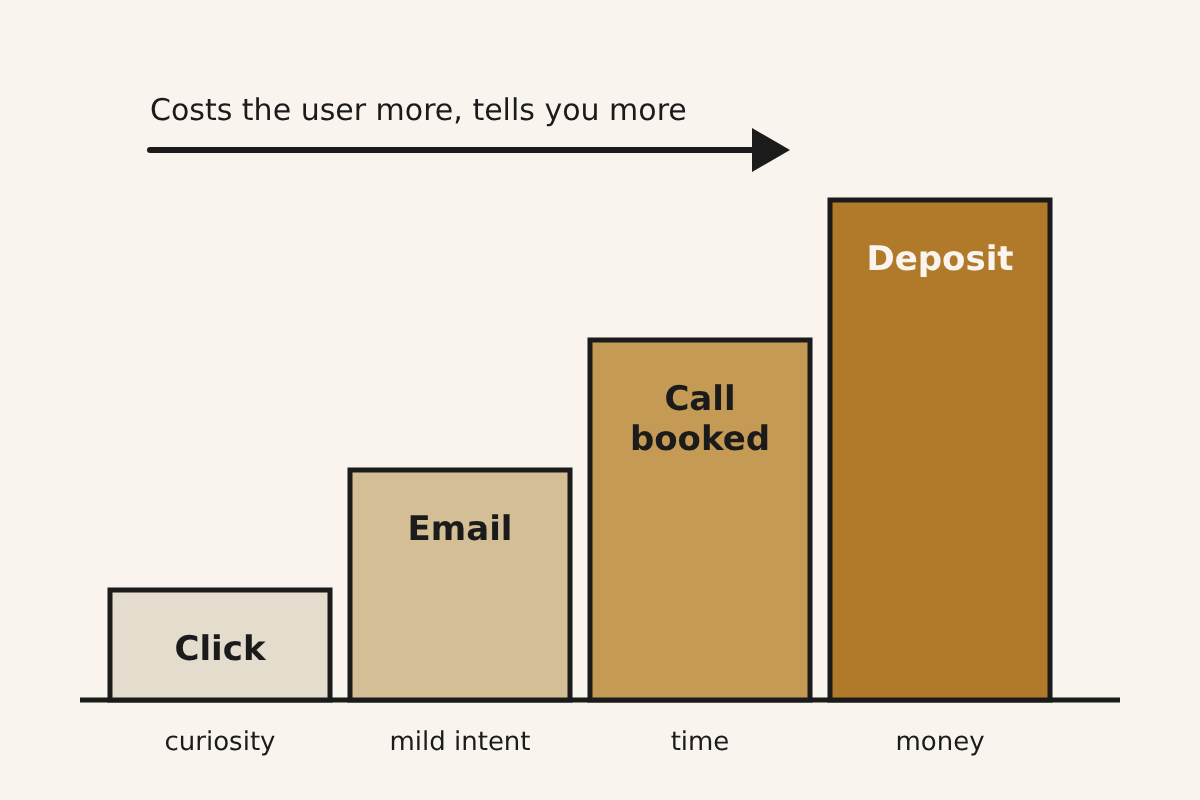
Rank what you ask for by what it costs the person giving it:
- A click shows curiosity. Count it, but never decide on it alone.
- An email, or a detail only they know (their accountant's address, their current tool), shows mild intent. They expect to hear from you.
- Time means a 20-minute call booked on your calendar. People rarely give time to things they do not need.
- Money means a refundable deposit or pre-order, only once you can honestly say when it ships. That belongs in a pre-order test, not on a fake door.
Pick the strongest ask the moment can carry. Inside an app, an email or a booked call usually fits. A deposit on a fake door crosses the line from test to deception.
That is the line this blog draws every time: compliments, sign-ups and demo gasps are flattery; money, time, referrals and retention are evidence. Market Fit Alpha is built around a four-step loop of assumption, experiment, evidence and alpha, run before you build rather than after, and a fake door is one way to run the experiment step. Its free Field Kit of worksheets and templates is a good place to write the assumption and the threshold down before the test starts, so nobody can quietly move them later.
A worked example
Here is how the numbers go for an invented team. The figures are illustrative, chosen to show the arithmetic.
A small invoicing app has about 2,500 weekly active users, of whom 1,200 send at least one invoice a week. The team suspects many of them email PDFs to their accountant by hand, and wants to know whether a direct send is worth six weeks.
They write the assumption above: at least 4% of the 1,200 click, at least a third of clickers leave an email. They show the button only to that group, for two weeks, next to Download.
Two weeks later:
- 1,140 of the 1,200 saw the invoice screen with the button.
- 61 clicked. That is 5.4%, above the 4% line.
- 14 left an accountant's email. That is 23% of clickers, below the one-third line.
Half a pass. Curiosity is there; commitment is thinner than the team hoped. The honest reading is not "build it" and not "kill it". It is a smaller next test: email the 14, book calls with as many as will talk, and ask what they do today, step by step, the last time they sent an invoice to their accountant. If several of them describe the same tedious workaround and say they would switch to a paid plan for the fix, that is evidence. If they describe something different from what the button promised, the door was in the wrong wall.
How many people need to see the door
Small teams cannot run tests on hundreds of thousands of visitors, and they do not need to. They do need enough people that one click does not swing the answer.
The arithmetic is simple. With 40 viewers, each click moves the rate by 2.5 percentage points, so a 4% threshold is decided by a single person. With 1,000 viewers, each click moves it by 0.1 points. As a working rule, plan for enough viewers that your threshold is at least 20 to 30 clicks; below that, treat the result as a direction to explore, not a verdict.
If your traffic cannot get there in two or three weeks, change the test rather than waiting months. Interview ten users from the target group without naming the feature, ask them to walk you through how they handle the job today, and see whether the pain comes up on its own.
When to stop
Set the end date with the threshold, before launch. Stop on that date, read the numbers against the line you wrote down, and take the button out. A fake door left up for months turns into a broken promise for everyone who clicks it later.
Three outcomes, three moves:
- Both numbers clear the line. Move up the ladder: calls, then a concierge version done by hand, then a pre-order once you can name a ship date.
- Clicks clear, commitment does not. Talk to the people who committed. The interest may be real but the solution wrong.
- Clicks miss. Write down what you learned, close the door, and test the next assumption. A clean no in two weeks is cheap compared with six weeks building something nobody opens.
Whatever the result, write it up while it is fresh: the assumption, the threshold, the numbers, what you decided. Next quarter, when someone suggests the same feature again, that note is the cheapest evidence you own.
